
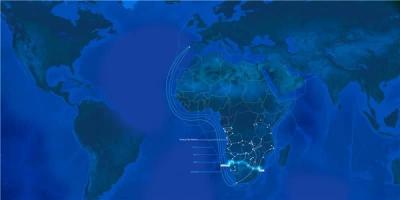
The new state-of-the-art terrestrial fiber network extends from the east coast of Africa in Maputo, through Johannesburg and across Botswana and Namibia, to the west coast of Africa at the Cable Landing Station in Swakopmund, Namibia. Paratus is the landing partner for the Equiano Subsea Cable in Swakopmund, Namibia. This strategic East-West route bolsters the Paratus regional network infrastructure and provides unmatched reliability and low-latency connectivity across Southern Africa.
"Our East-West fiber route isn’t just a line on a map — it’s Africa’s digital lifeline."
Paratus Group Chief Commercial Officer, Martin Cox says the new fiber East-West route uniquely combines local expertise with global reach. “As a steadfast partner with pan-African expertise, we offer unequalled wholesale capacity solutions for network operators. Because we understand the unique connectivity needs of the various regions, we have tailored our solutions to specific requirements, and we offer carriers and operators not only a diverse East-West route but also onward transmission to Europe.
Recent undersea cable cuts have shown the importance of robust alternatives and why we’ve built redundancy into every kilometre, ensuring Southern Africa stays connected, no matter what. This isn’t just about backup—it’s about uninterrupted operations and seamless communications. With Paratus, you’re partnering with innovators who are weaving resilience into Africa’s digital landscape.
Notes to editors: The Paratus Group has made significant investments in its extensive and diverse fiber network. Earlier this year, Paratus completed a 1,890 km fiber route from Johannesburg, through Botswana, to Swakopmund. This Botswana Kalahari Fiber (BKF) spans across Botswana into Namibia, connecting to the Cable Landing Station (CLS) in Swakopmund and the Paratus-landed Equiano subsea cable, which extends from Namibia to Lisbon, London, and the rest of Europe. Connecting to the East-West fiber route, Paratus operates the fastest fiber express route from southern Africa to Europe via the Equiano subsea cable. Using Infinera FlexILS and GX Series DWDM equipment, latency on the new route is just 123 milliseconds and can support wavelengths of up to 800Gb. The Paratus express route gives network operators the opportunity to elevate their capacity and redundancy to provide resilience and high-speed performance as standard, and to guarantee smooth data flow and minimal service interruption.
Paratus is committed to raising the bar for providing quality connectivity in Africa. With an eye on the future, the group is investing in infrastructure and establishing itself as a key player in delivering integrated network services across the continent. Among its many and diverse achievements, the group has invested in and launched the East-to-West Africa fiber route and the express route from Johannesburg to the rest of the world. The Group has operations in 15 African countries and employs approximately 800 people across the group. The business extends further to provide satellite connectivity-focused services in more than 30 African countries. This connects African businesses across the continent and delivers end-to-end service excellence. The group’s footprint extends beyond Africa to international points of presence (PoPs) in Europe, the UK, and the USA. Born and bred in Africa, Paratus is thinking big as it grows its footprint to deliver Africa’s quality network. The Group aims to deliver real value and services to communities across Africa, while making a positive contribution to transformation in terms of both the people and the environment.